A list of fake crypto trading websites can help identify a reported domain, but it cannot certify that an unfamiliar platform is safe. Names change, genuine brands are impersonated, and a new site may not yet appear in a warning database.
Start with the exact address and independent records. The examples below come from California's Department of Financial Protection and Innovation (DFPI) Crypto Scam Tracker, checked on November 21, 2026. They are followed by a practical verification process you can apply before opening an account or transferring assets.
Examples from an official crypto scam tracker
The DFPI tracker is based on consumer complaints. The department says it has not verified complainants' reported losses. These entries describe reported experiences, not court findings or our independent investigation of the operators. Similar names may belong to unrelated businesses.
The addresses are deliberately written with [.] so they are not clickable. They identify the reported domains, not destinations to visit.
| Domain in the DFPI tracker | What the complaint describes |
|---|---|
zdfzxer[.]com | A purported trading platform demanded a further payment for verification before withdrawal. |
eqitouprime[.]com | A withdrawal was conditioned on paying a subscription fee. |
pc[.]pisame[.]com | A consumer reported being unable to withdraw funds after an earlier small withdrawal. |
ovaro[.]net | Requests for processing fees, purported taxes and a security deposit followed a withdrawal attempt. |
bcex-global[.]online | A consumer reported a demand for additional temporary margin before access to funds. |
This is a small historical sample, not an exhaustive blacklist or a statement about present domain ownership. A match warrants caution; no match is not clearance to deposit.
How to check a crypto trading website
Treat each claim as something to verify separately. A polished trading screen, a company registration document and a friendly support conversation answer different questions. None replaces checking who operates the service and where your money would go.
1. Record the precise domain and business identity
Copy the full address into a private note without opening unfamiliar downloads. Record the claimed legal entity, business location, regulator and registration number. Keep the address actually shown in your browser, rather than relying on the logo or the name in a chat message.
The FBI warns that fake platforms can imitate legitimate websites and present convincing account dashboards. An address containing a familiar brand somewhere in its text does not establish that the brand controls the website. Likewise, an app's availability in an app store does not settle whether its investment claims are genuine.
2. Consult warning records independently
For a US-facing service, useful starting points include the DFPI Crypto Scam Tracker and the CFTC's registration and disciplinary-history resources. Reach the agency independently instead of following a verification link supplied by the promoter.
Search the exact domain as well as the business name. Compare spelling, subdomains and contact details. Save the date and the result of each check. If a complaint concerns a similarly named site, establish whether the addresses actually match before drawing conclusions.
The CFTC also recommends checking whether a domain's registration age fits the company's story. A recently registered address claiming a long operating history is a discrepancy to investigate, not proof by itself.
3. Check what a registration actually covers
A certificate sent in a message is not independent confirmation. Investor.gov warns that fraudsters falsely claim SEC registration and that the SEC does not issue registration certificates.
Look up any claimed registration in the relevant official database. Compare the legal name, status, contact information and scope of activity. If an entry lists different contact details, use those independently obtained details to investigate the mismatch. A real firm's record can be copied by an impersonator.
Registration is also not a promise of investment returns. A business's presence in one register does not establish that every product on a similarly named website is authorized or that your funds are protected in the way a salesperson claims.
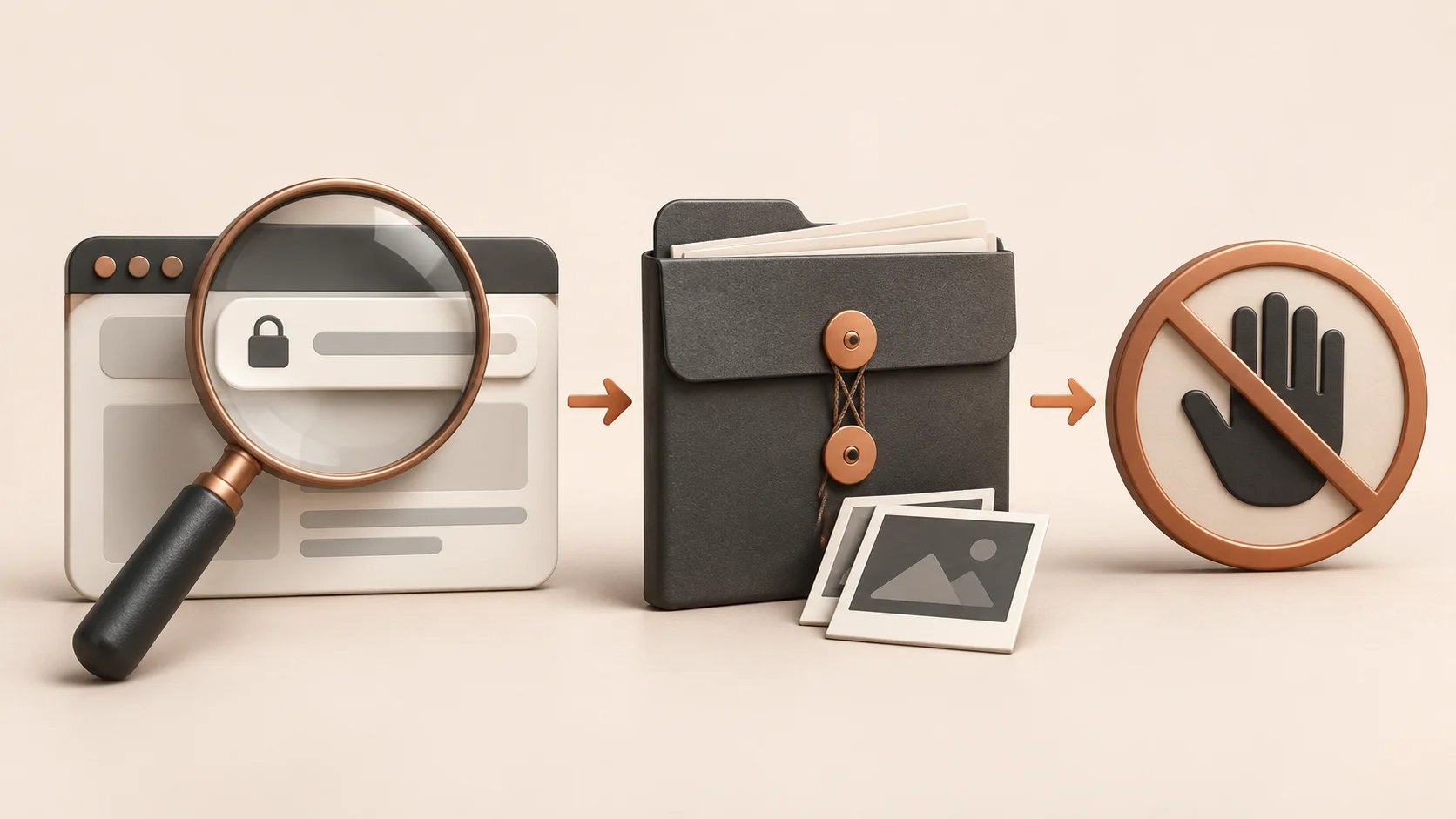
Conceptual illustration of checking a website's identity, records and payment request; not a security certificate or endorsement.
Warning signs in the trading and withdrawal process
The CFTC describes platform frauds in which account screens show supposed profits but withdrawals lead to demands for additional payments. The balance on that screen is a claim by the website; it does not independently prove that assets are available to you.
Pause if a platform or promoter:
- Promises a fixed profit or a risk-free trading program.
- Pressures you to add money immediately to unlock a special status.
- Explains a withdrawal failure by demanding a new deposit for taxes, verification or an undisclosed fee.
- Tells you that normal questions from your bank or exchange should be concealed or answered with a fabricated story.
A legitimate service can have disclosed charges and compliance checks. The concern is an unexpected demand to send more money to release a claimed balance, especially when the explanation changes after each payment. Ask for the applicable written terms and verify the company through independently obtained contacts. Do not let an invented deadline substitute for that work.
Why a small successful withdrawal is not enough
The FBI notes that scammers may permit early withdrawals to build trust. A small payment arriving in your wallet therefore does not prove that larger amounts remain accessible or that displayed trading profits are real.
Consider a hypothetical sequence: someone deposits $100, withdraws $20, then is urged to transfer $5,000. The $20 only demonstrates that a payment occurred. It does not verify how the larger deposit would be held. Treating that payment as proof of safety asks it to establish far more than it can.
If you have already sent money
Stop making additional payments to unlock the balance. Preserve the domain, messages, screenshots, dates, transaction hashes, wallet addresses and transfer amounts. In the United States, the FBI directs suspected cryptocurrency-investment-fraud victims to its Internet Crime Complaint Center. Use an independently located official reporting channel.
Contact the financial institution or exchange used to send the funds promptly. The FTC notes that cryptocurrency payments are typically difficult to reverse, but recommends reporting the fraudulent transfer to the provider. Recovery is not guaranteed.
Be cautious of anyone who contacts you claiming they can recover the funds for an advance fee. The FTC warns that recovery scams target people who have already lost money. A new promise to rescue the original investment can become another payment demand.
If you only want to learn trade bookkeeping, a manual crypto paper-trading ledger can be kept without depositing funds or connecting a wallet to an unfamiliar service.
Checking platform identity is separate from deciding whether a trade is affordable. A genuine platform can still offer trades that lose money. Our guide to crypto trading capital and costs covers that separate question once the service itself has been evaluated.
Official warning records and consumer-protection guidance checked November 21, 2026. No list can identify every fraudulent website.